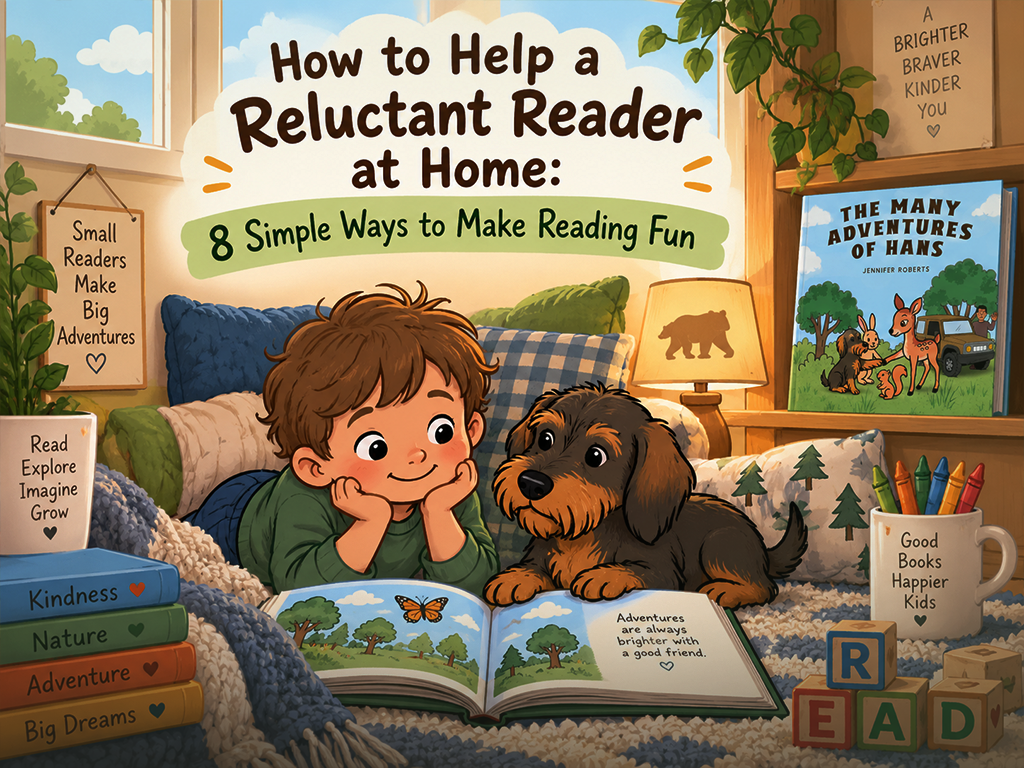

The first days of school can bring big feelings.
A child enters an unfamiliar classroom and does not know where to sit. Perhaps they have a question but feel nervous about raising their hand. Often, they are uncertain about whom they can trust or where they belong.
A thoughtful social-emotional learning book can help children recognize and discuss these emotions through story. In The Many Adventures of Hans, a curious wire-haired Teckel becomes lost in the forest, admits that he is frightened, asks for help, and discovers that everyone has a different strength to contribute.
For teachers and parents preparing for the new school year, it is a versatile classroom read-aloud for children ages 4 to 8, and one of the most practical back-to-school additions to any reading plan.
Why Back-to-School Is the Right Time for a Social-Emotional Learning Book
Back-to-school is not just about pencils and backpacks. In fact, it is about transition. And transition, for young children, almost always involves a full range of emotions they do not yet have words for.
Fortunately, strong social-emotional skills can help children handle challenges, form friendships, and manage stress. Moreover, a well-chosen social-emotional learning book gives children both the vocabulary and the emotional model they need before those challenges arrive.
The Many Adventures of Hans introduces children to five core SEL competencies through story rather than instruction, drawing on the framework established by CASEL, the Collaborative for Academic, Social, and Emotional Learning. Self-awareness, when Hans recognizes he is scared and does not pretend otherwise. Self-management, when he chooses to keep moving instead of shutting down. Social awareness, when he notices his new friends each have something different to offer. Relationship skills, when he accepts help and contributes his own strength in return. And responsible decision-making, when he trusts the smoke signal and follows it toward home.
None of these are presented as lessons. They happen inside a forest adventure, which is exactly why they land so well with young readers.
The Moment Hans Asks for Help
There is one moment teachers can return to when discussing how to ask for help.
Hans is lost. He is hiding behind a tree, eyes shut tight, body shaking. When he finally opens one eye and discovers that the sound behind him was not danger but a deer named Lucy, he does something simple but meaningful. He tells the truth immediately.
He says: I am lost. I need to find my owner.
For many children starting a new school year, saying those words out loud is one of the hardest things in the world. Admitting you do not know where you are is difficult enough. Beyond that, acknowledging you need help feels even harder. And accepting that the situation is bigger than you can handle alone takes real courage.
Hans does it without hesitation. And because he does, everything changes. As a result, Lucy, Jack, and Ellie do not judge him. Instead, they say yes and get to work.
This makes the book a natural conversation starter for the first week of school. Before reading, ask children: what do you do when something feels unfamiliar? Who are the people you can ask for help? Does asking for help mean you are not brave? Then read the story and revisit those questions together.
Four Characters, Four Strengths: A Classroom Activity
One of the richest children’s book themes in The Many Adventures of Hans is that every member of the team contributes something different, and the group is stronger because of it.
Importantly, this maps directly onto the classroom community teachers work to build at the start of every school year. To bring this theme to life, use this simple activity after reading:
Draw four boxes on the board. Label them Jack, Ellie, Lucy, and Hans. Ask children what each character does to help the group find its way home.
Jack spots broken twigs on the trail and notices what others miss. Meanwhile, Ellie climbs the tree and becomes the eyes above the canopy, going where others cannot. Lucy, in turn, walks beside Hans and says “you are doing great” at exactly the right moment, providing steady encouragement. Finally, Hans puts his nose to the ground and follows scents no one else can read, using his greatest natural gift.
Then ask each child: what is your strength? What do you notice, or reach, or encourage, or sense that others might not? Have them draw or write their answer in a fifth box labelled with their own name.
This activity connects directly to the book’s core message: you do not have to be the hero of the story. You just have to show up with what you have.
The free printable activity sheets on the activities page extend this further with Hans-themed coloring pages, mazes, and creative worksheets that work well in a first-week classroom setting.
A Read-Aloud Resource That Works All Year
The Many Adventures of Hans is not a one-time read. Rather, it is the kind of picture book for ages 4 to 8 that teachers can return to as different SEL themes become relevant throughout the year.
In September, it opens conversations about starting something new and finding your people. In October, it supports discussions about teamwork and different kinds of intelligence. In November, it pairs naturally with gratitude themes because Hans is deeply grateful for his friends and for Mike. In January, it works for new beginnings and the courage to try again.
For more on what makes Hans work well in a classroom setting, the post on what makes a great classroom read-aloud offers practical guidance for teachers.
The Hans-themed activity sheets also give teachers a ready screen-free classroom activity that connects directly to the story without requiring additional prep.
Frequently Asked Questions
Q1: What makes this a good social emotional learning book for back to school?
It covers five core SEL competencies through story. Children see self-awareness, managing fear, building friendships, asking for help, and contributing to a team modeled naturally by Hans and his forest friends.
Q2: What age group is this book best for?
It is written for children ages 4 to 8. Younger children connect with the illustrations and animal characters. Older children engage more deeply with the emotional journey and teamwork themes.
Q3: How can teachers use this as a classroom read-aloud?
Read it aloud in the first week of school and follow up with the four strengths activity described above. Ask discussion questions before, during, and after reading. Use the free printable activity sheets to extend the experience with hands-on creative work.
Q4: Does this book address asking for help?
Yes. Hans admits he is lost and needs help in a way that is clear and age-appropriate. The story shows asking for help as an act of courage rather than weakness, which is a useful message at the start of a new school year.
Q5: Can this book support screen-free time in the classroom?
Yes. The book and the accompanying printable activity sheets make a complete screen-free experience. Teachers can use the coloring pages and worksheets as quiet time activities or follow-up work after the read-aloud.
Q6: Where can I get a copy for my classroom?
The Many Adventures of Hans is available on Amazon and through Jennifer’s website. Visit the book page for all available formats and ordering details.